Pages

Nov 12, 2015

"Chick Flicks to the Rescue"

We have a new bull.   
Here he is.
(We don't use artificial insemination so 
we have to rotate/replace our bulls every two years
 when their heifer/daughters reach the age for a first pregnancy.)


As bulls go, 
he is considered downright gorgeous!
(Check out the muscular body - broad face - nice eyes...)

For the first few days we had him stay in a roomy pen
 in the Young Animal barn,
 so he could have a chance to settle down 
 and get used to his new surroundings. 
(He seemed pretty aggressive but that was to be expected in a new bull. )

We didn't have a name for him yet,
 and we still had a few cows in the herd who were also nameless, but other issues were crowding in at the time so we put that one on hold.

 When the cold, wet days of Autumn begin
 it is fairly straightforward
 to bring in the cows for milking.


They actually come from the field themselves
and wait at the gate for us to unhook it.
Then they gallop through, anxious to be into the warm barn,
 where they know the grain feeders are full,

and the fresh hay is on the feeding table.

But two days ago...

the new guy in town was let out into the field for the first time and 
had his chance to meet some of the

"prettiest girls in Sweden,"

(...that would be our milk cows.)

The response was every young man's bull's dream:

they loved him!

Every cow wanted her chance to be near him, hunk that he was,
especially at the water cup where a girl could really get 
up close and personal.


But when it came time for the cows to come in to be milked, 
this young cow refused!

There were several of us there, the leaves were falling from the trees, 
the icy wind was blowing,
 and the dampness was chilling, 
so I went to the fence to talk to both of them...

 I tried to reason with the cow first, 
reminding her that it was time to come into the warm barn, 
and how uncomfortable she would be if she missed her milking.
She looked at me squarely, 
considered what I had said for a moment, 
and then, to the astonishment of all present, 
she shook her head NO! 
(See the blurring there with her head shaking?)


Amazed, but spurred on by the unlikely , (but seemingly apparent) comprehension of the two, 
I appealed next to the bull. 
Reminding him that  - #1. he was in our employ,  
and #2. he could go onto the 
"S" list
( the "S" stands for "Slaughter")
at any time for erratic behavior.
 I encouraged him to give the cow a nudge toward the barn.
The response was identical.  He looked at all of us head on ,
and shook his head NO!
(Note the blurring of the bull this time.)

They stayed out in the field together
the entire night.
The next morning it occurred to those of us who 
had a penchant for all Jane Austen videos,
but "Pride and Prejudice" in particular ,
that this scenario was dangerously close to providing 
the perfect name for the new bull and also for that particular cow....


"Mr. Wickham and Lydia".

quoting from the video ALMOST verbatim and describing the determined, and disobedient eloping lovers of the tale,
 we said, in our best Mr. Bennett voice:

"....Mr. Wickham and Lydia have been discovered in London and
she will not leave him..."

The name problem was solved!


Jan 4, 2014


"Mighty Joe Banks" 
and his 
"Beautiful Assistant"
(PART II)

Pappa and Joe moving the super heavy threshing machine.
First,  let's talk about the threshing barn and the threshing barn:

The original threshing barn (shown above) on the farm was filled with machines, odd equipment, pieces of wood,  old furniture the onion racks and the remnants of a skateboarding ramp that the boys had built years ago. 
We knew that we had to get it cleaned out and organized so that it could hold the amount of straw we would need for the animals when the cold weather hit.  
The straw chopper is housed in one corner of that threshing barn and works with an ingenious vacuum system that blows the chopped straw through pipes and into the straw room in the small animal barn.   
From there we can basket it up and spread it in the stalls in both barns to keep the animals warm and clean.
The road to Ericsson's.
Loading the bales on the trailer.

And with the threshing barn cleared it would mean fewer trips to Arne Ericsson's farm on the other side of Junsele where we get our straw. 

Fewer trips = less gas = less expense. 


Heading home with the load.

In Sweden gas is about $10.00 per gallon and hauling a trailer loaded with bales of straw sucks up the gas 
fast!

Joe was a whirlwind and between he and Pappa they cleaned the entire thing out.  
Terrific!

 The newly emptied threshing barn meant room for a winter's supply of straw.  
A winter's supply of straw meant the chopping could begin.  


I  had been working in the house and glanced out the window to see them unloading all the new straw bales through the big black double doors .  
The next thing I heard was the straw chopper starting up.

 
A half hour later Joe sent Pappa to get me with the camera and this is what I saw...
Joe had filled the room full and was reclining...straw covered from head to toe, on the top layer.  
So fun!


Months later when it was time for the calfing to begin we still had plenty of clean fresh straw to get all the pens ready for the new babies.

Spurred on by their success in bringing the original threshing barn up to snuff, 
 Pappa, Gustav and Joe decided to tackle the building of the  new/old threshing barn that we had moved onto our farm the year before
 ( You can read about it in a former post called "Lincoln Logs"). 
This is the barn that was taken down log by marked log from another village and was to be used as a storage facility and parking garage for our cars. 


The previous winter we had covered the logs to protect them out in the field.
Here Gustav and one of our dear missionaries who had come with his companion offering a "service day" on the farm,  laid the large metal sheets on the piles so the logs wouldn't rot.


In northern Sweden there is a great emphasis on  wasting nothing.  

I had seen the big pile of rocks out behind the hay barn for years, but until the boys started erecting the new threshing barn I had no idea what the purpose was for all those boulders.  
These were large rocks that had once been foundation stones for other buildings on the farm and when the buildings were moved or the lumber used for other things the rocks were put in one place for future use.  
Hans and Gustav took the tractor out and the loading began.


Earlier they had measured and marked and staked out the perimeter with Joe.


One by one the stones were roped and hauled to the building site.
Holes were dug according to the measurements that had been taken and the foundation stones were sunk and laid.

Positioning the next stone.
The corners were laid and leveled.


And then came the logs and floors and roof and trusses that had been out in the front field waiting for this time.
The assembly began in earnest.


With the tractor and forklift they hoisted each log and swung it over into place.


Joe directed, Gustav acted as the counterweight, and the progression was steady.

Again, two of our missionaries volunteered for a day on the farm and moved more and more of the seemingly endless pile,


and on this beautiful Autumn day, Pappa checked the joints at every corner, and we called it done for that season.  

We felt so good about what we had been able to complete on such a big project.
We were moving along.

Second, let's talk about the upper floor of the källarboden
 (root cellar building):


1.  The chaos on the upper floor of the källarboden with household articles piled everywhere.

2.  The cinder blocks and boards Joe and Gustav brought over and put up for me.

3.  Everything organized on the shelves according to composition:
 wood, iron, copper, etc.


4.  The floor swept and the only things left over in one corner - 
the canning supplies to be used the next Autumn.
Hooray!!

No more trekking over to the frozen källarboden in the dead of winter trying to find something I needed for the kitchen before hypothermia set in!

Third,  let's talk about calf boxes:


See these three gated boxes?  
They are invaluable come late winter/early spring when all the babies start to be born.  Each week-old baby is put into a box to learn to drink from a bottle when he/she is separated from the mother.

But we had a problem:


The cement workers who  made the pad the boxes stand on poured them too short from front to back so the entire year before we could only get two of the small boxes in that space and they had to be turned sideways with the gates facing each other. 
Can I just say that when you were standing in the middle space between the two boxes feeding a bottle to a calf in one box, another calf in the box behind you was biting your back and other unmentionable parts of your body by putting his/her head through the bars in the gate?

Not good.

When the babies are born it is still super cold outside so there is nowhere else to put them safely except in these boxes. 
We are in a remote part of Sweden so there was little chance that we could get a qualified workman back again to correct the cement pad problem in a timely manner.

It was Gustav, in his brilliance,
 who found the solution, 
(and it was so simple that we wondered why in the world we hadn't thought of it before).

Can you guess how he did it? 

After taking a closer look, he saw that the metal strips would allow him to dismantle the boxes one by one and cut down the wooden sideboards and the wooden floor slats by enough - it only took about 20 cm - to make them fit in the space we had,
facing front!

Not only did they fit front to back with the stability we needed on the cement pad,
 we were able to put all three in there side by side, 
ready for calfing.

With that solved, we could turn our attention to: 

Water!

Oct 29, 2013


"Mighty Joe Banks" 
and his 
"Beautiful Assistant"

 (Get some cookies and a drink...this is a LONG post)


Joe Banks from Cornwall, England and Sara Rivera-Olsson from Göteburg, Sweden

When we are into October on the farm there are  three"W's" that always cause concern.
They are:

         1.  WEATHER  
2.  WATER
3.  WINTER
WEATHER:


During the day the temperature will generally hover around zero but at night it is almost always in the minus department. 

Hauling a load of bottled saft to the root cellar.
Nainy and Sara with the last of the beets!

The good news about that  is that we must have lower temperatures in order  to get the root cellar down below 5 degrees.  
That way no mold can grow in there.
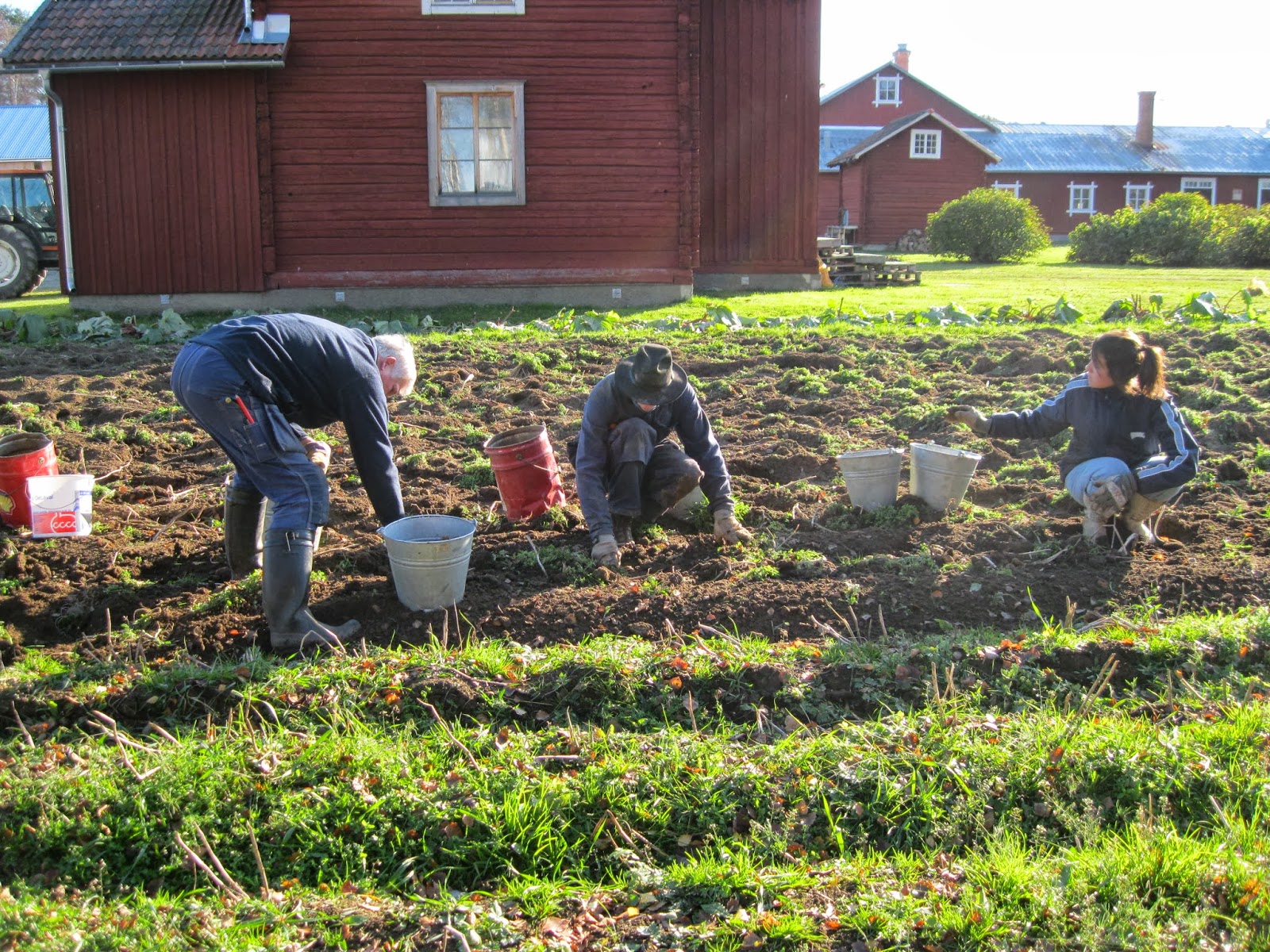
In late Autumn we are emptying the last of the root vegetables out of the garden.  
These are the ones that only need to be bagged, braided, or crated such as  potatoes, onions,  carrots, parsnips, beets that are not going to be pickled,  etc. 


On the day we harvested the potatoes it was cold but clear and the "bumper crop" continued as we filled bag after bag.  

Double the normal amount of potatoes!
Parsnips and Carrots in their crates.
The parsnips were beautiful and bountiful as were the carrots - this picture shows only a small fraction of the total yield.

and I say "bountiful" remembering Joe pulling armfuls of them out of the ground. 

Dubbed by the kids, "The Conglomerate Carrot".
Ruby beets destined for the Borscht pot.


and then there were the onions...

We decided to try a new plan and set up the onion drying racks in the small animal barn since it wasn't time yet to bring the heifers and calves in for the winter. You can see the racks on the left side of this picture - there were five layers and we had three different varieties of onions -  white, yellow and red.  The plan was to dry them all on the racks and then braid them down and hang them in the tank room (which wasn't finished yet and consequently had no tanks taking up the space) to see if it would be the right environment for them.

Sara braided the reds,


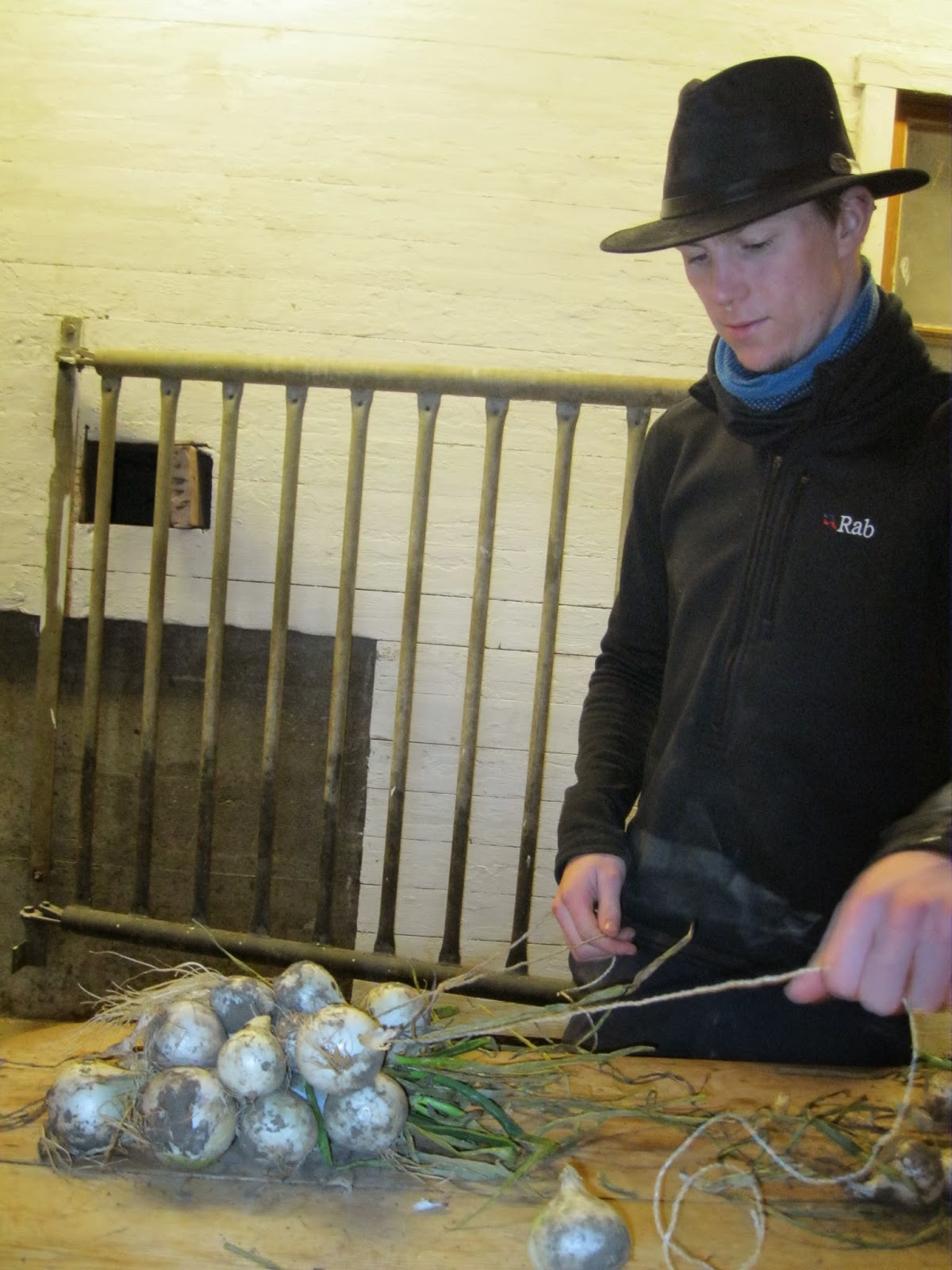
When they had all dried we chose a rainy day - perfect for the indoor work - got the twine that would be woven in to stabilize each bunch, moved in a work table, and started in:


Joe worked on the whites.


I attacked the yellows,


We had tried so many different places on the farm in the past and couldn't seem to hit the ideal location for the onions.  The root cellar was too damp, other places were either too cold or too warm or too light.


As we finished each bunch we hung them from the metal gates all over the barn until we could transport them to a hanging bar in the tank room.

This was Joe and Sara at the end of day #1 and they were still smiling!
It took us two full days and another evening,  but in the end we got all of them braided and ready to hang.
We ended up with a total of just under 
300 lbs. of onions 
for the year!